If chopping an onion feels like a workout, your vegetables come out in uneven chunks, and you've had a few too many near-misses with your fingers, here's the truth most home cooks never hear: it's almost never you. It's the knife. A dull blade, an awkward grip, and the wrong technique turn a simple task into a slow, frustrating, slightly dangerous chore.
The good news is that great knife skills for beginners come down to three fixable things: a sharp knife, a proper grip, and a little practice. Get those right and you'll chop faster, safer, and with far less effort. Let's fix your knife problem for good.
First, the Counterintuitive Truth: Sharp Knives Are Safer
It sounds backwards, but a dull knife is far more dangerous than a sharp one. A blunt blade slides off tough skins and slips across hard vegetables, and when it slips, it heads straight for your fingers. It also needs more force, which means less control.
A sharp knife bites in exactly where you place it and glides through food with gentle pressure, so you stay in control the whole time. Keeping your knife sharp isn't a fussy extra. It's the single biggest safety upgrade you can make.
You Only Need One Good Knife
Forget the giant block of fifteen knives. Most of them gather dust. For nearly everything you cook, you need just one: a good chef's knife, around 20cm (8 inches) long. It chops, slices, and dices almost anything.
If you want to round out your kit later, add a small paring knife for peeling and trimming, and a serrated bread knife for loaves and tomatoes. That's it. One excellent chef's knife you keep sharp beats a drawer full of blunt ones, and it's the kinder choice for a budget too (more on spending wisely in our budget cooking guide).
How to Sharpen a Knife (and Keep It Sharp)
There are two different jobs here, and people often confuse them.
Honing
Honing realigns the edge that bends out of true with everyday use. Run the blade down a honing steel at a slight angle, a few strokes per side, every few uses. It takes seconds.
Sharpening
Sharpening removes a little metal to create a fresh edge, and you only need to do it every few months. Three easy options for how to sharpen a knife:
- A pull-through sharpener is simplest for beginners. Draw the blade through the slots a few times.
- A whetstone gives the best results. Hold the blade at roughly a 15 to 20 degree angle and draw it across the wet stone, alternating sides.
- A professional service is worth it once or twice a year if you'd rather not do it yourself.
To test sharpness, slice a sheet of paper. A sharp knife cuts a clean line. If it tears or catches, it's time to sharpen.
The Grip: Hold Your Knife Like This
Most chopping struggles disappear once your hands know what to do. Take it slowly the first few times.
Your knife hand (the pinch grip)
- Hold the knife where the blade meets the handle.
- Pinch the base of the blade between your thumb and the side of your bent forefinger.
- Wrap your other three fingers around the handle.
It feels strange at first, but pinching the blade (not gripping the handle like a hammer) gives you far more control.
Your other hand (the claw)
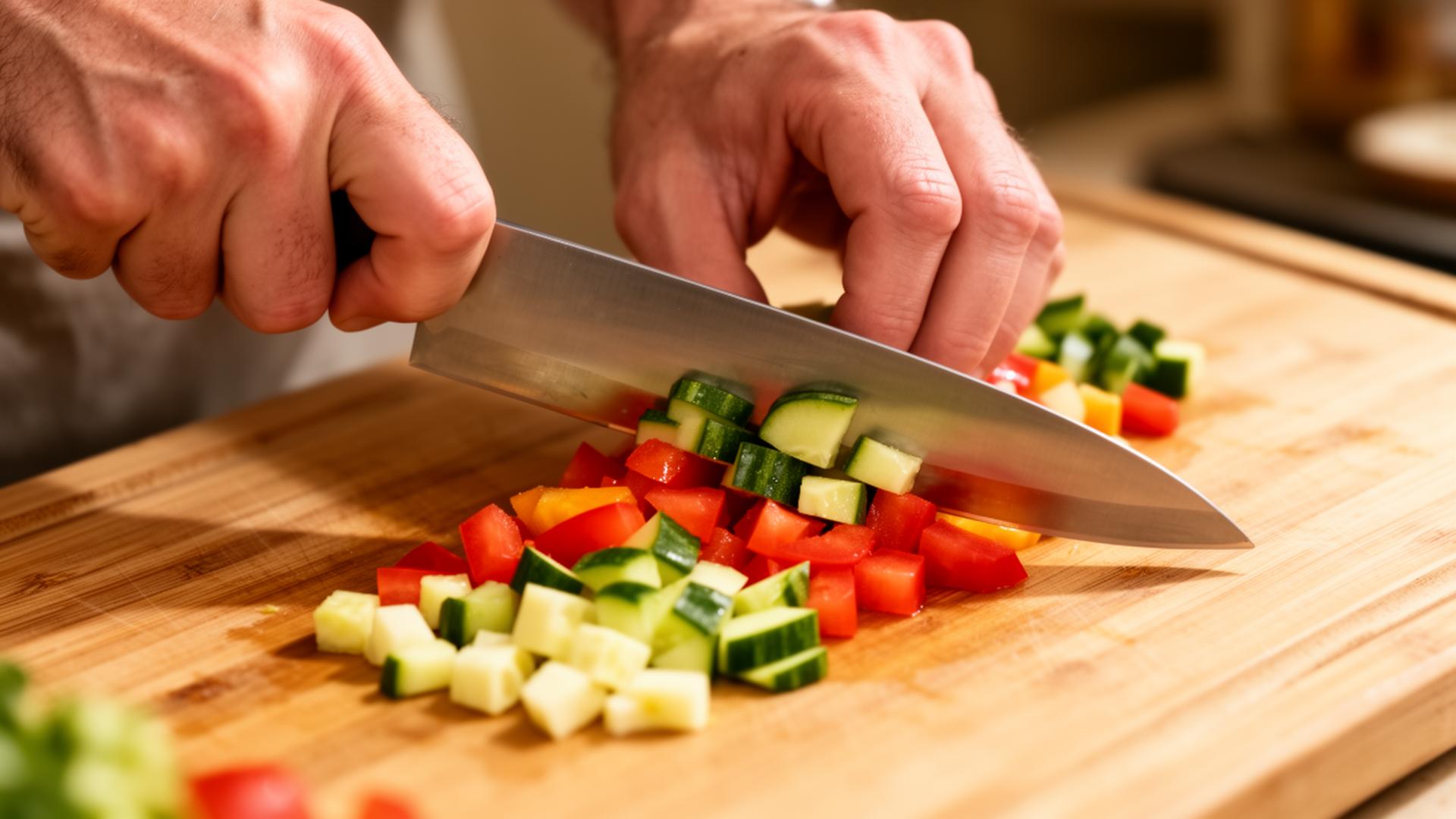
- Curl your fingertips under, as if holding a ball.
- Hold the food in place with those tucked fingertips.
- Rest the flat side of the blade against your knuckles so they guide the cut.
Done this way, your fingertips never come near the edge. This one habit prevents the vast majority of kitchen cuts.
The Motion: Let the Knife Glide
Don't lift the knife high and chop straight down. Instead, keep the tip near the board and push or rock the blade forward through the food in a smooth slicing motion. Let the sharp edge do the work rather than forcing it. Slow and smooth at first, then speed comes naturally with practice. That's the whole of good chopping technique.
Safety First, Always
A few simple rules keep all ten fingers where they belong:
- Stabilise your board. Lay a damp cloth or paper towel underneath so it can't slide.
- Never try to catch a falling knife. Step back and let it drop.
- Cut on a flat surface, never in your hand.
- Keep your knife sharp, because a dull one is the real hazard.
Frequently Asked Questions
- What knife should a beginner buy first?
- A single good chef's knife, around 20cm (8 inches), handles almost every task. It's the best first purchase for knife skills for beginners, far more useful than a block set.
- How often should I sharpen my knife?
- Hone it on a steel every few uses to keep the edge true, and properly sharpen it every few months, depending on how often you cook. The paper test tells you when it's due.
- Why does my knife slip when I chop?
- Usually because it's dull. A blunt blade slides off food instead of biting in. A sharp knife, a proper claw grip, and a stable board fix it.
- What's the safest way to hold food while chopping?
- Use the claw grip: curl your fingertips under and guide the blade with your knuckles, keeping your fingertips tucked safely away from the edge.
The Bottom Line
Slow, frustrating, scary chopping isn't a sign you're bad at cooking. It's a sign your knife needs help. Keep one good chef's knife sharp, hold it with a pinch grip, guide your food with a claw, and stabilise your board. Those few changes make every recipe faster, safer, and genuinely more enjoyable, even if you're starting from scratch.
Put your new skills to work: speed through prep with our 15 easy 30-minute weeknight dinners, get even cuts that cook evenly for better flavour in why your food tastes bland, and chop ahead like a pro with our meal prep guide.
What chopping job trips you up most? Tell us in the comments and we'll help.